Time Rewind is a series where we dive into the operations of Kenton County's departments to explain the progress each has made over the past eight years.
Each year, the Kenton County Emergency Communications Center fields more than 200,000 calls, but the process has not always been easy, and substantial investments in both technology and personnel have led to better outcomes that benefit the whole community.
“911 dispatchers are the unseen heroes; the calm voice in the dark, and oftentimes that means most people may not have any idea what their dispatchers are actually responsible for doing,” Ashley Hawks, KCECC director, said. “Our team is responsible for answering all 911 lines as well as non-emergency lines that come into the center. That means the person at the console could be triaging calls that range from a baby not breathing to answering a question about trick or treat or parade times in the next minute.”
Streamlined operations, technology drive results
Hawks said one of the biggest misconceptions about her team’s job is the technology available as they work to address residents’ needs.
“Technology in real life does not match what you might see on a prime-time TV show that allows someone to see your exact location in real time,” she said. “Finding someone’s exact location takes hands-on work on the part of the dispatcher and that work takes time.”
It’s for this reason Kenton County has worked diligently over the past eight years to eliminate operational hurdles and invest in resources.
Prior to 2012, the county had three dispatch centers serving the community, Kenton County, Covington and Erlanger. Having three dispatch centers fielding calls resulted in several inefficiencies that slowed first responders down. (The map on the left shows the three communications centers that existed within Kenton County prior to their merger.)
As a result, officials from Kenton County worked to merge operations from both Covington and Erlanger into the county’s own, successfully doing so in September 2012 and May 2018, respectively.
The mergers helped to eliminate confusion between dispatch centers and provided a seamless transition of information for dispatchers covering multiple jurisdictions in Kenton County. The consolidation also resulted in cost savings for both Covington and Erlanger, with $1.5 million annually freed up for Covington alone.
Key technology investments include:
- Changing to CodeRED in May 2017. CodeRED is a mass notification system dispatchers can use to quickly contact residents and businesses in the event of an emergency. The new system replaced outdated technology to allow for more streamlined and faster communication.
- Upgrading computer aided dispatch (CAD). CAD serves as the nucleus of KCECC operations by helping to manage, organize and respond to all incoming calls. The upgrades made in 2018 allow for real-time, two-way communications between dispatchers and first responders - saving valuable time in potentially life-threatening situations.
- Participating in RapidSOS. RapidSOS provides data from cell phones to give dispatchers a more precise location for people in need. Before RapidSOS, our dispatchers relied on wireless carriers, who are only obligated to provide a location within a 50 meter radius. RapidSOS can pinpoint down to a street address. Having better location information greatly increases the likelihood first responders can help. Kenton County began using RapidSOS in March 2019, and in June 2023, the county expanded its use of the service to include tracking the location of the Kenton County Police Department’s body cameras to allow dispatchers to better help officers during foot pursuits.
- Creating a first-of-its-kind backup center. In 2022, KCECC created a fully redundant emergency operations center within the main county building in Covington while its Independence facilities underwent renovations. This backup center now serves as a regional model for our Northern Kentucky peers.
However, officials’ efforts to drive efficiencies were not limited to solely internal efforts. Kenton County was a leader in conversations with Boone and Campbell counties to increase regional collaboration.
Those efforts resulted in two major victories, starting in 2019 when Cincinnati/Northern Kentucky International Airport, along with Boone, Campbell, Gallatin, Kenton and Pendleton counties adopted a regional phone system. That system allows participating agencies to use other agencies’ phone systems in the event their system goes offline.
And in 2020, KCECC spearheaded the launch of a regional digital radio system so officials across Boone, Campbell and Kenton counties can more easily communicate. This transition also created greater coverage, allowing dispatchers to keep a continuous communication channel with first responders in areas previously inaccessible, such as some multi-story buildings.
“When citizens pick up the phone and dial 911 there is an expectation that someone will answer and send the resources they need in an emergency,” Hawks said. “This system grants us immediate access to the appropriate resource for our citizens in their time of need.”
 Engaging employees by focusing on whole health
KCECC, under Hawks, adopted a 360 Wellness Initiative to help address employees’ physical and mental health.
“While there is certainly a dire need for programs that provide reactive assistance, I felt Kenton County needed to be proactive for our employees and head off what seemed to be inevitable,” Hawks said.
“Instead of waiting for the symptoms of PTSD, burnout and secondhand trauma to alter the lives of one or more of our employees, we developed the 360 Wellness Initiative, allowing us to provide training and resources to educate our employees on how to take care of themselves so they can better take care of others.”
Since its 2021 inception, this program has included group training to identify signs of burnout or stress and the creation of an anonymous portal for employees to access resources.
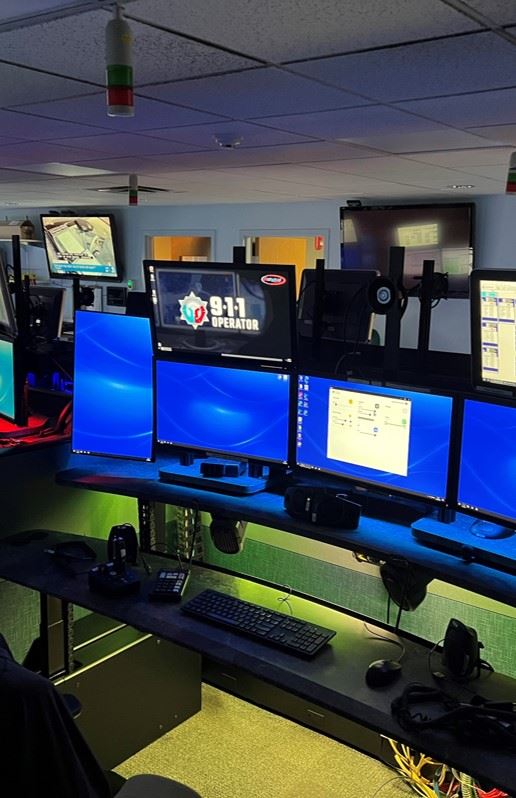
And in 2022, the county invested in state-of-the-art, ergonomic workstations to provide dispatchers an improved environment to work their 12-hour shifts.
“The two greatest outcomes of our program have to be the way our staff is continually on the lookout for one another and how they have normalized discussion about the effects the profession can have on your mental health,” Hawks said.
What’s next for KCECC?
Moving forward, there are three areas to highlight for the center’s next steps:
- Creating a regional computer aided dispatch (CAD) system. Each day dispatchers and first responders from Boone, Campbell and Kenton counties work together to provide public safety for our residents. By establishing a regional CAD, officials could eliminate several of our remaining efficiency hurdles by boosting transparency and sharing seamlessly among our teams.
- Evaluating dispatch center spacing needs. Space limitations currently prohibit KCECC from hiring more than two dispatcher trainees at a time when the county is currently running at an employee deficit.
- Establishing a Northern Kentucky Dispatch Training Academy. Currently, the KCECC and its regional peers rely on the Kentucky Department of Criminal Justice Training in Richmond to train future dispatchers. If Northern Kentucky created its own regional training academy, officials could not only shave off training time but also save money on travel expenses. Such programs are currently operational in Louisville and Lexington.